
001 - In Conversation with carrie R
CARRIE R (b. 1990, New Jersey) is a Philadelphia-based sculptor who negotiates the space between drawing and three-dimensional form. Working in aqua-resin and fortified cement clay embedded with pigment, she builds biomorphic structures that reference emotional reactions, freak accidents, and solitary moments—expressing a sensitive relationship to gravity that emerged from years of material experimentation. Her work has been presented with Pamplemousse Gallery (Richmond) and Good Mother Gallery (Los Angeles), alongside fairs such as SPRING/BREAK and Upstate Art Weekend. She will also be showing at Satellite Art Fair during Miami Art Week (Dec 4-7, 2025). Ahead of her studio sale on December 7th and presentation at Satellite, we sat down with carrie to discuss material experimentation, the freedom of making, and why her work needs to feel just a little bit weirder.
R: The surfaces of your sculptures have such a distinctive quality—both in texture and color. Could you walk us through how your material process evolved?
carrie R: A big part of my process is really influenced by materials. I used to build everything with chicken wire and plaster, but when you mix pigment into plaster, it comes out really pastel—I didn't love that. So I was working mostly in black and white, which actually pushed me to start drawing on the sculptures with oil bars. That was a real moment of discovery. After that, I switched to aqua-resin. It's a powder and liquid mixture that hardens—a lot of people use it to make molds, but I use it more like paint. I make it a thicker consistency and put the pigment right into it, so it's strengthening and coloring at once. The pieces end up super lightweight but really strong.
The vibrant color actually came from a side project I had a hard time with at first. A couple years ago, I started making functional objects—pots and lamps. Because it was such a low-stakes project, I really started experimenting with color. I was squeezing pigments so richly into the aqua-resin, playing with textures and combinations I never would have tried on my "serious" work. And then I brought all of that back into my sculptures. The color process didn't exist until I had something that felt less consequential or risky—and that freedom let me experiment.
R: How do you approach form and gesture in your sculptural work?
carrie R: A lot of it comes from thinking about drawing and then pushing that three-dimensionally. The way to make something three-dimensional from a line is to make multiples of that line, and it can start to take on these organic, almost creature-like qualities. But for me, I'm really just playing with gestures. My mantra when I'm working is: how can I make it just a little bit weirder? I'll sit in front of a piece and think, it needs to feel stranger. What if the limbs don't continue in the direction you expect, but just go off to the side? Or I'll add something to throw off the symmetry. I'm always pushing it in that direction.
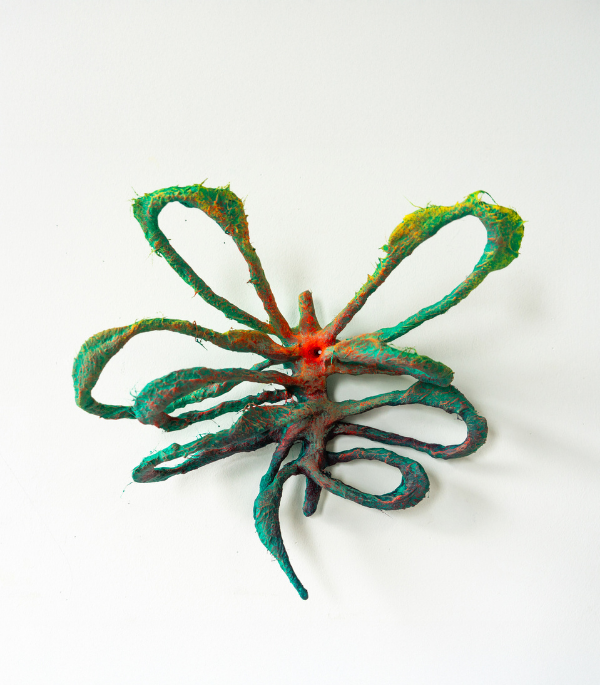
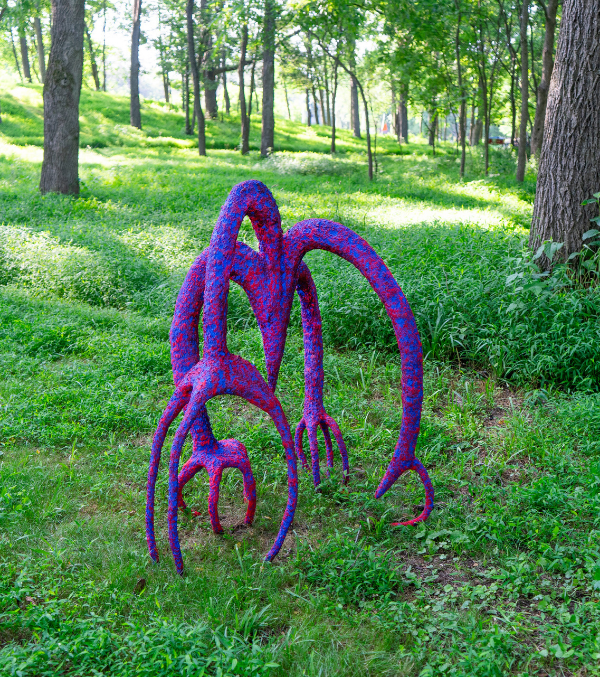
Left: fly in the vaseline, 2025, Right: protector 1, 2025R: Your work has such a strong relationship to gravity and movement. Do you mind elaborating on that? carrie R: It's something I didn't plan but couldn't avoid. About thirteen years ago, a month after I graduated art school, I had a serious accident that impaired my mobility for a while. As a sculptor, you can't help but think about your body's relation to the world. I didn't want to make work about my body or the accident, but I realized I kept coming back to questions about what it means to put something in space and to take up space. If a piece is going to lean against a wall, why? I want each piece to have a really specific relationship to gravity—to depend on a particular design to balance. Sometimes I'll give something a little limp, or a side hip. Movement and balance became the gestural components I'm most interested in.
R: Your day job is in communications—how does that relate to your art practice?
carrie R: Everything else in my life is super planned. In communications, I'm telling a really specific story. And right now with AI, authorship and authenticity are getting pretty fuzzy. I feel more than ever that there's nothing more human than your imagination. I've had studio visits where people want more of a narrative—some deeper story. But this is the one place in my life where I can experiment just because I can. I can play, pull things from my imagination, sit in front of a piece and let my mind dictate where it goes next. The art being the opposite of planned storytelling is really important to me.
Huge thanks to Carrie for participating in this interview and allowing me into her studio. It was a real pleasure to see her work in person. For her upcoming Holiday Open Studio event, Carrie will be selling work alongside painter Michael Saunders.
